
3D Printing Enabling
Automobile development and manufacturing
From conventional fuel cars to new energy cars,Light quantification, integration, complex structures and rapid product iterativeHigher requirements are being placed on the manufacture of vehicle parts.
The traditional form of foundry usually involves the development of wood moulds, core boxes and assembly at the research and development stage of new products, and the modification and re-manufacturing of moulds increases the time and cost of research and development when products are frequently restructured.
Pass.3DP sand 3D printing technologyThese can be based directly on three-dimensional models for the manufacture of complex sand and sand cores, reducing the reliance on traditional moulds, providing more flexible responses to product design changes, and providing efficient digital manufacturing pathways for vehicle parts development, engineering certification, single test and small and medium batch manufacturing.
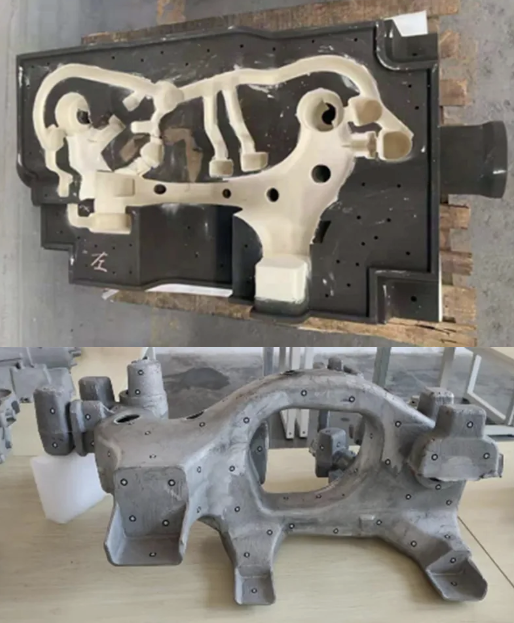
New Energy Heavy Card / Commercial Card Sub-Road
Large side shelf withLarge size, thin walls, complex structures and high integration requirementsFor other characteristics, higher requirements are placed for sand manufacturing, refilling and size control.
Through the 3DP sand printing combined with digital casting, complex sand formations can be manufactured directly based on three-dimensional data, combined with the subsequent manufacture of parts and components, reducing the development of traditional moulds, and providing more flexible manufacturing methods for the development of research and development of large vehicle structures and rapid iteratives.
.png)
Oil filter seat
Engine parts like oil filters are usually available.Complex internal pipelines, multifunctional integration and integration structuresFor example, traditional foundry requires a complex combination of sand cores, with higher requirements for manufacturing cycles and process stability.
Using 3DP sand printing techniques, it is possible to directly manufacture sand cores and sands with complex internal structures, reduce input from traditional core boxes and molds, and provide digital solutions for the development, structural optimization and rapid testing of new products for complex car foundries.
Accelerating auto innovation
Towards digital manufacturing
From rapid testing to complex car casting, LAYWON uses industrial 3D printing equipment, technology and manufacturing services to provide more flexible digital manufacturing pathways for automobiles and new energy automobiles.
Whether it’s new research, complex structural verification, or single and small batch parts, we can use you.3D models, materials, dimensions, quantities and application requirements, assist in assessing suitable 3D printing and manufacturing programmes.
New energy car complex casting
New energy cars for partsLight quantification, structural integration and R & D efficiencyIncreased demands were made.
3D printing and digital foundry technology for applicationElectric case, light quantitative frame, structural shell and other complex aluminium alloy castingR & D manufacturing, directly driven sand production through digital models, rapid response to restructuring and resizeing of products, providing more flexible production methods for new energy vehicle R & D and small and medium mass manufacturing.
Core value of 3D printing in the automobile field
Reduce the input of molds
The direct manufacture of sand and sand cores through three-dimensional models reduces the dependence of new products on traditional wood models, core boxes and complex garments during the development phase.
Accelerate product overlay
The change in design will allow rapid access to new manufacturing processes through the modification of digital models and will be better suited to the rapid development and continuous iterative needs of the automobile industry.
Advantages of 3D print products
Creating complex structures
To break some of the limitations of traditional models in terms of complex inner cavities, heterogenesis, thin walls and integrated structures, and to expand the freedom of design of car foundries.
Support small batch soft manufacturing
Applicable toEngineering samples, functional validation, single test, multiple varieties and small and medium batch production, reduce the cost pressures associated with traditional modelling of small quantities of products.